 CAPACUANSMALL SCALE
From rock to gold: the traditional way and our plant.
How small-scale miners in Camarines Norte have long processed gold ore, how our plant does it, and why the difference matters for output, recovery, safety and the environment.
- 1–2tOre crushed and ground per hour at our plant
- 50–100kgOre per batch in a traditional rod mill, in 5+ hours
- ~30%Gold typically recovered with mercury
- 90+%Gold recovered by our leaching process
The basics
Two kinds of gold in the rock
Why gold ore has to be processed at all.
Some gold in our veins is free gold: grains and pieces big enough to see. Because gold is far heavier than rock, free gold can be caught by gravity once it is broken loose.
Much of the gold, though, is in grains finer than sand, spread through the quartz and the sulphide minerals around it. That gold cannot be seen or picked out. The rock has to be crushed and ground to a fine powder first, and the gold then has to be recovered from that powder.
So how well and how fast a miner can crush, grind and recover decides how much of the gold in the rock actually ends up as gold.
General explainer.
The traditional way
Hammers, rod mills and mercury
The method many small-scale miners in the district still use.
Crushing by hand. Miners break the ore with hammers until the pieces are small enough for the mill. This alone takes hours of hard physical work.
Grinding in a rod mill. The broken ore goes into a rod mill: a steel drum turned by a small motor, with heavy steel rods inside that tumble and grind the rock. One batch is usually about 50 to 100 kg of ore and takes around three hours. Including the hand crushing, a single batch takes five hours or more.
Recovery with mercury. The ground ore is mixed with mercury, which sticks to the gold and forms a soft lump called amalgam. The amalgam is then heated to drive off the mercury, leaving the gold behind. In practice, this recovers only about 30% of the gold in the ore; the rest stays in the waste.
Batch sizes, times and recovery are typical figures from our own experience in the district, not laboratory measurements.
Our way
Crushing, grinding and leaching in one plant
One integrated line, from ore to doré, without mercury.
Crushing. A jaw crusher breaks the ore from the veins into gravel in minutes, with no hammering by hand.
Grinding. A wet pan mill and a ball mill grind the gravel with water into a fine slurry. Any free gold that is released can be caught by gravity at this stage.
Leaching. The slurry goes into leaching tanks, stirred by motor-driven agitators, where a dilute sodium cyanide solution, kept alkaline with lime, dissolves the fine gold and silver. This carbon-in-pulp method is the standard used by most gold mines worldwide.
Recovery. Activated carbon in the tanks soaks up the dissolved gold and silver, which is then stripped from the carbon and melted into doré bullion.
Because crushing, grinding and leaching run as one line, our plant can crush and grind about 1 to 2 tonnes of ore an hour, and the leaching process recovers more than 90% of the gold.
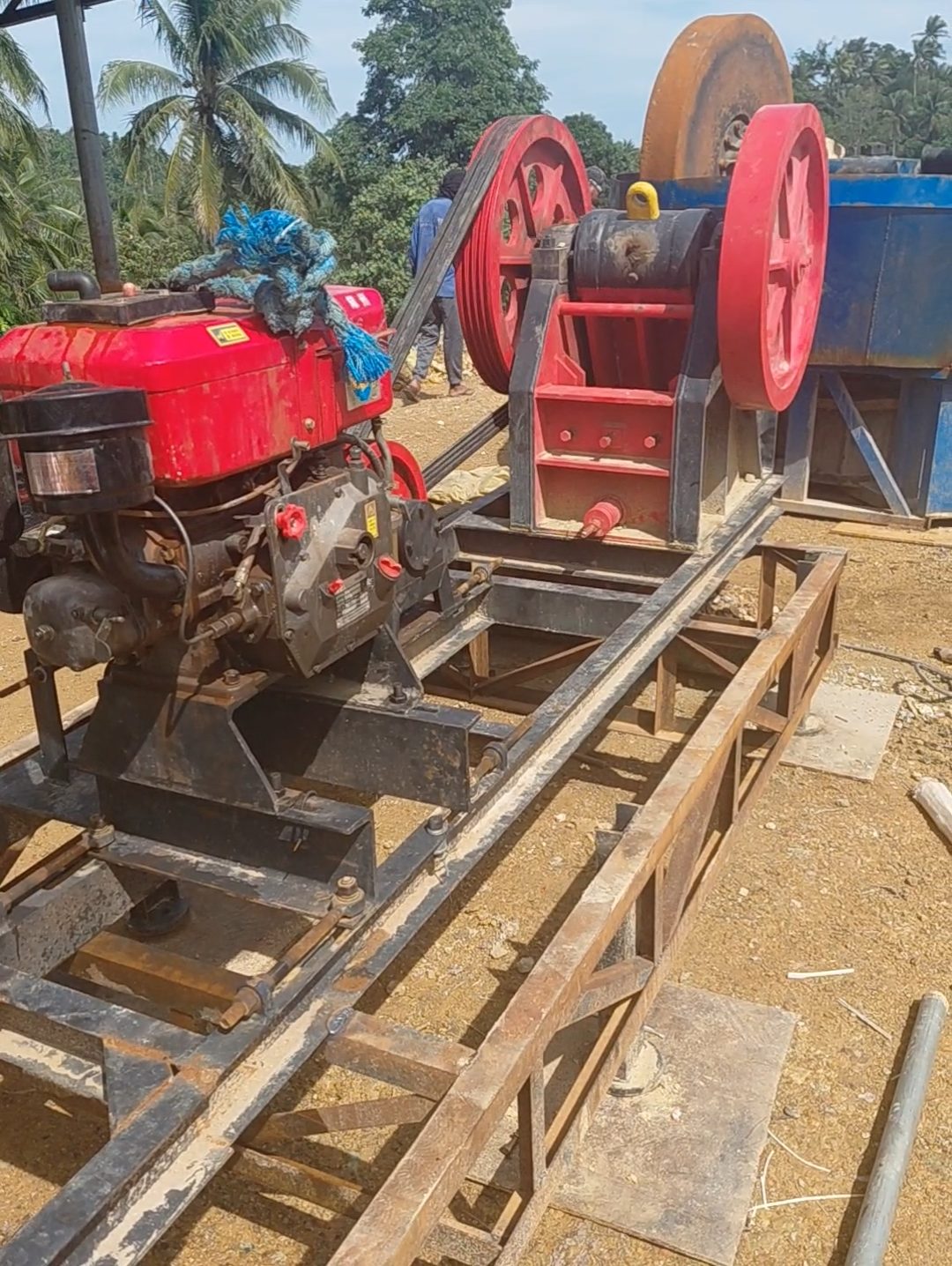
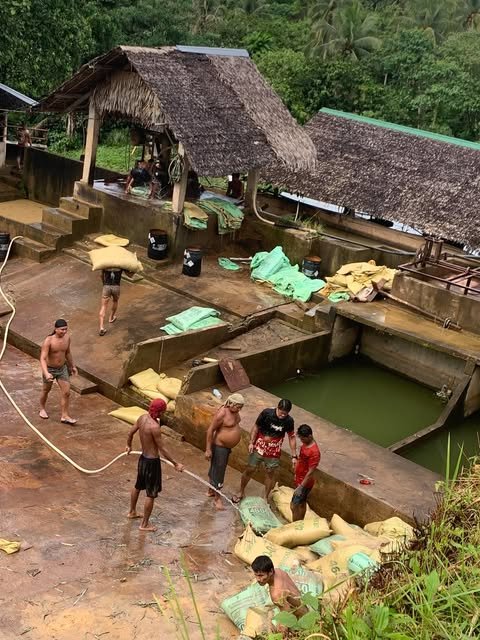
Throughput and recovery are approximate figures for our plant, given by the association.
Side by side
The traditional way and our plant, compared
| Traditional | Our plant | |
|---|---|---|
| Crushing | TraditionalBy hand, with hammers | Our plantJaw crusher |
| Grinding | TraditionalRod mill, about 50–100 kg per batch in around 3 hours | Our plantWet pan mill and ball mill, in one continuous line |
| Time and volume | Traditional5 hours or more for one batch of 50–100 kg | Our plantAbout 1–2 tonnes of ore crushed and ground per hour |
| Gold recovery | TraditionalMercury amalgam, about 30% | Our plantCyanide leaching with carbon, more than 90% |
| Mercury | TraditionalUsed, and released into air and water | Our plantNone |
| Safety | TraditionalHeavy manual work, flying rock chips, mercury fumes | Our plantMachines do the heavy work; chemicals stay inside the leaching tanks |
Evidence
What the research says
Our figures match what studies of small-scale mining have found.
A 2024 report by the International Labour Organization (ILO) on chemical exposures in mining puts the gold recovery rate of mercury at 20 to 50%, against around 60 to 90% for cyanide. It adds that whole-ore amalgamation, where all the ground ore is mixed with mercury, rarely captures more than 30% of the gold.
A 2009 study by Veiga and colleagues in the Journal of Cleaner Production found the same pattern. Amalgamation recovered less than 30% of the gold, while leaching the ore with cyanide in a mill reached 93% gold extraction in laboratory tests on ore from Indonesia and 95% at an artisanal mine in Ecuador.
Actual recovery always depends on the ore and on how well a plant is run, but the gap between the two methods is large and well documented.
Sources: ILO, Chemical exposures in mining: impacts for occupational safety and health (2024), pp. 14 and 19; M. Veiga, D. Nunes, B. Klein et al., “Mill leaching: a viable substitute for mercury amalgamation in the artisanal gold mining sector?”, Journal of Cleaner Production (2009).
Health and environment
Why we do not use mercury
Mercury is cheap and simple, but its cost is paid by the miners and the rivers.
When amalgam is heated, the mercury turns into vapour. Breathed in, it damages the nervous system, kidneys and lungs, and the people most exposed are the miners and families who burn amalgam at home. Mercury washed out with the waste also ends up in streams and rivers, where it builds up in fish and in the people who eat them.
Small-scale gold mining is the largest source of man-made mercury emissions in the world, according to the United Nations Environment Programme. The Minamata Convention on Mercury, which the Philippines has ratified, calls for its use in small-scale gold mining to be reduced and, where feasible, eliminated.
We have worked with planetGOLD, the UN Environment Programme-led programme to end mercury use in small-scale gold mining. The cyanide used in our leaching tanks is also toxic, which is why it is used only as a weak, alkaline solution kept inside the leaching tanks.
Sources: UNEP Global Mercury Assessment (2018); Minamata Convention on Mercury; World Health Organization fact sheet on mercury.
In short
What the difference means
Better recovery, more ore, and no mercury.
From the same rock, our plant recovers roughly three times as much of the gold as the mercury method, processes far more ore in the same time, and keeps mercury out of the community.
Together with machines in the mine itself, this is what sets our association apart from traditional small-scale mining in the district.
Figures are approximate. Recovery depends on the ore, and nothing on this page is a promise of returns.
Gold mining investment · Philippines
Join us as an investor.
Contact us for site details, survey information, plant information and our plans. We reply within two business days.
Or email us directly:
Mining investment carries risk, including the loss of capital. This website is for information only and is not an offer of securities.